Pollybeak Deformity

A pollybeak deformity refers to an excess prominence, or contour, in the region of the nose immediately above the tip of the nose. A pollybeak is typically classified as being a result of either cartilage or scar. Therefore, you will often see the terms cartilaginous pollybeak and soft tissue (scar) pollybeak used, respectively, when discussing this rhinoplasty topic. In most cases, a pollybeak deformity results from prior rhinoplasty surgery. It is much less common to see a pollybeak deformity that is congenital in nature.

Cartilaginous Pollybeak Deformity Following Prior Rhinoplasty

A cartilaginous pollybeak deformity usually arises in someone who had prior rhinoplasty to reduce the bridge height. Normally these are rhinoplasty patients who originally had a dorsal hump, or bump. In most cases of a dorsal hump, reduction of the bridge involves taking down both the cartilage and the bone to achieve a nice smooth, nasal profile. Unfortunately, some rhinoplasty surgeons fail to adequately remove the entire cartilage portion of the bump. This exact point is demonstrated visually in the adjacent rhinoplasty diagrams.

On the left is a nose with a dorsal hump or bump. When you remove a hump like this, you need to reduce the height of the cartilage (yellow) and bone (blue) in a fairly equivalent fashion to achieve a nice straight, smooth profile. The middle photo below shows what the ideal goal of hump reduction is in rhinoplasty. In a pollybeak deformity resulting from prior rhinoplasty, some of the cartilage that should have been removed is still present. This area of residual cartilage is referred to as the supratip region. As is seen below right and indicated by the white arrows with red outline, the lower portion of the bridge cartilage is still intact while the remainder of the bridge (above the red arrow) has been taken down. In this particular situation, the middle and upper bridge is at the correct height and has been reduced properly. But the supratip portion immediately above the tip region is still excessively high. This remaining portion that should have been removed along with the rest of the bridge directly accounts for the cartilaginous pollybeak deformity.

Soft Tissue Pollybeak Deformity Following Prior Rhinoplasty

A soft tissue pollybeak deformity can also arise as the result of prior rhinoplasty. We call it a soft tissue pollybeak because the abnormal prominence is from scar tissue and not from excess cartilage in this region. In the soft tissue pollybeak deformity, the cartilage has been adequately reduced to address the unwanted hump. But when you reduce a bump like this you are relying on the overlying skin to shrink down to the new level of the bone and cartilage. In rhinoplasty patients who have thin skin, this shrink wrapping occurs readily. In rhinoplasty patients with thicker skin, though, this shrink wrapping occurs much slower. In the meantime, your body is trying to heal and as part of this healing process will lay down scar tissue where the old cartilage and bone used to be. If your body lays down scar tissue at a faster rate than the skin shrinks wraps, a soft tissue pollybeak can result. In the rhinoplasty diagram below right, this excess, unwanted scar tissue is represented by the red shaded area in the supratip. In a similar fashion as excess cartilage does, the excess scar tissue deposited in the supratip creates a prominent contour that results in the pollybeak deformity. So why does the soft tissue pollybeak form in this particular area and not somewhere else along the bridge? This is because the skin and soft tissue are naturally a little thicker in the supratip area. If there is going to be a preferential area of scar tissue formation, it classically occurs right here.

Rhinoplasty Patient Examples Of A Pollybeak Deformity

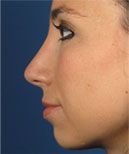
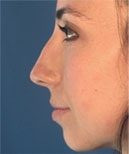
The appearance of a pollybeak deformity is nearly the same when comparing the cartilaginous type with the soft tissue type. This is best appreciated on the profile view of someone’s nose. As you can see in the adjacent rhinoplasty patient examples, there is an unwanted prominence immediately above the region of the nose where the tip transitions into the bridge. Both of these patients had undergone prior rhinoplasties by different plastic surgeons. They then developed a pollybeak deformity that, in both cases, was a cartilaginous pollybeak.

Management Of A Pollybeak Deformity

Management of a pollybeak deformity depends on whether you are dealing with a cartilaginous or soft tissue type of abnormality in the supratip.

Treatment of a cartilaginous pollybeak requires removal of the residual cartilage prominence in the supratip. This can be accomplished by a revision rhinoplasty specialist using either a closed or open rhinoplasty approach. During the revision rhinoplasty the residual supratip cartilage is shaved down and the skin is then allowed to shrink wrap down to the new shape.

Treatment of a soft tissue pollybeak deformity in the supratip is focused on getting rid of the dense, unwanted scar tissue. In many cases, a rhinoplasty expert should be able to see the slow development of a soft tissue pollybeak. After all, the development of a soft tissue pollybeak occurs over months not days or weeks. Therefore, in between regular follow-up visits your rhinoplasty specialist should be able to appreciate if the supratip region is slowly enlarging or not. If so, they can begin injecting a steroid solution into the supratip to minimize further scar tissue deposition. In addition, injection of steroids into a soft tissue pollybeak can in some cases reverse the process and help avoid formal revision rhinoplasty surgery altogether. In many of these revision rhinoplasty patients, repeated steroid injections (termed serial steroid injections) have to be done over several months to achieve the desired result. If serial steroid injections do not achieve the desired outcome, revision rhinoplasty surgery may be warranted to correct the soft tissue pollybeak. In a similar fashion as is done with the cartilaginous deformity, the offending scar tissue can be surgically excised, or removed, to create a more pleasing profile view.

Before & After Photos Of A Pollybeak Deformity Correction

The following patient presented to our office following prior rhinoplasty by a different plastic surgeon. She was unsatisfied with the appearance of her nose and sought out a revision rhinoplasty specialist with experience in managing a pollybeak deformity. As you can see from her before revision rhinoplasty photos, Her frontal and oblique views were also impacted by the pollybeak deformity. On frontal view, you can see that her supratip appears quite wide. In fact, once her nose was opened up in surgery, she indeed had a very prominent and wide segment of residual cartilage in the supratip region. In addition, her nasal bones and tip cartilage were wider than desired, which compounded her nasal appearance. This patient underwent an open revision rhinoplasty. This included reduction of the cartilaginous pollybeak deformity. At the same time we performed osteotomies to narrow her nasal bones and refined her tip. The after revision rhinoplasty photos demonstrate a marked improvement in terms of her overall nasal appearance. Now note how her nose looks more defined with a more feminine shape and size. These photos represent a stable postoperative result over one year out from a revision rhinoplasty procedure.